
The UK construction sector and certain of its adjacent verticals are operating under intense, increasing pricing pressures that threaten the ongoing stability of small companies and contractors (SMEs). Recent reports show high numbers of insolvencies in the industry, as well as mounting wage bills, rising transportation costs, and persistent materials price inflation.
For example, transportation costs account for 34% of total skip hire operational expenses, compared to just 18% in 2019. Regulatory changes like the ban on diesel have triggered operational cost increases of 23-31% across medium-scale construction projects. And the list of cost disruptions goes on.
On top of all of these challenges, new operational obstacles have emerged, most of them related to regulatory changes (the newly implemented Simpler Recycling rules). Operators, and even private individuals, are now forced to comply with strict environmental standards in how the waste generated in construction projects is disposed of and managed.
Among other changes, the traditional approach to waste management of simply throwing everything into one large skip is now forbidden.
All workplaces in England must legally separate their waste before collection. For construction sites, this new legislation requires making major operational and logistical adaptations in daily operations. Businesses must ensure that dry recyclable materials (such as plastic, metal, glass, paper and card) are properly separated from non-recyclable residual waste.
Adapting to these new environmental regulations has become a major priority, but implementing such operational adaptations has a cost.
Consider the most common types of building work undertaken across the sector, such as home improvement, renovation, and major works. These projects generate specific by-products depending heavily on the trades involved. Plumbers and HVAC trades generate metal piping and plastic offcuts, while bricklayers produce heavy, dense inert rubble. To protect tight profit margins, separating these specific streams is absolutely crucial. Clean brick and concrete can be classified under specific EWC Codes, such as 17.01.02, which are significantly cheaper to responsibly dispose of at landfills than mixed municipal waste. Maximising on-site waste separation is key to consistently maximising profits, as diverting recyclable materials can quickly lead to much lower overall disposal costs.
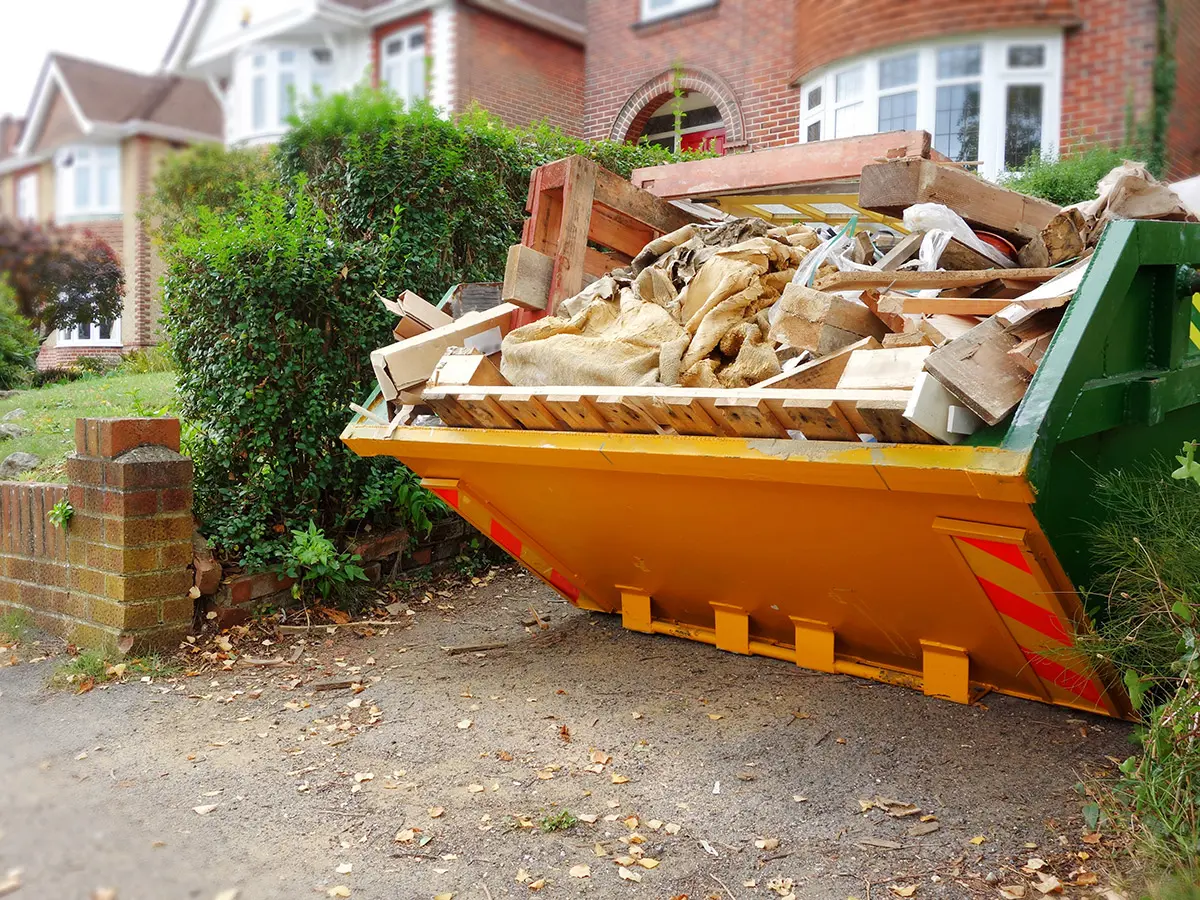
However, physically achieving this on small residential sites often proves to be a logistical nightmare. Many SME builders operate on highly restricted footprints, such as narrow residential driveways or busy urban streets. Finding sufficient room to place multiple containers for separated dry recyclables alongside a main bin is often practically impossible. Furthermore, the industry relies heavily on complex reverse logistics, meaning the process of moving goods efficiently from a project site to a proper disposal facility is vital. If a waste transfer station rejects a load due to extreme contamination, contractors face the massive headache of full bins being stuck indefinitely on customers’ driveways.
In addition, from early 2025, the standard landfill tax rate rose significantly to £126.15 per tonne. Conversely, the lower rate for clean, inert waste remains much more manageable at £4.05 per tonne. This sharp increase reflects a deliberate government strategy to discourage landfill disposal while simultaneously attempting to encourage recycling, reuse and material recovery.
For any building firm, the higher landfill tax directly increases project outgoings. Waste management firms and skip-hire operators must inevitably pass these escalating operational costs on to their customers (usually contractors and small businesses). Consequently, every load destined for landfill that contains unsegregated materials carries a significantly larger fee than contractors previously experienced.
For ongoing operations, contractors must urgently review their waste volumes and composition to avoid these inflated charges.
Implementing these rigorous separation practices requires dedicated time and manpower, which highlights another critical issue: the skilled labour shortage. The industry is currently battling the so-called ‘missing million’, needing hundreds of thousands of new recruits just to meet baseline demand.
Research reveals that a vast majority of firms report a severe lack of skilled workers, which already leads to frequent project delays. When site managers cannot recruit a qualified carpenter or an experienced bricklayer, pulling existing tradespeople away from their core duties to manually sort through mixed builders waste undermines project efficiency.
The ongoing construction skills shortage continues to put serious, compounding pressure on SME builders, making the added administrative and physical burden of waste segregation even harder to manage.
Ultimately, this perfect storm of logistical barriers, steep landfill tax hikes, and an acute labour crisis leaves SMEs with precious little room for error. Simply absorbing these additional expenses is no longer a viable strategy for survival. Instead, contractors are being forced to completely rethink project planning from the ground up, factoring in strict waste management protocols before the first shovel even hits the dirt.