
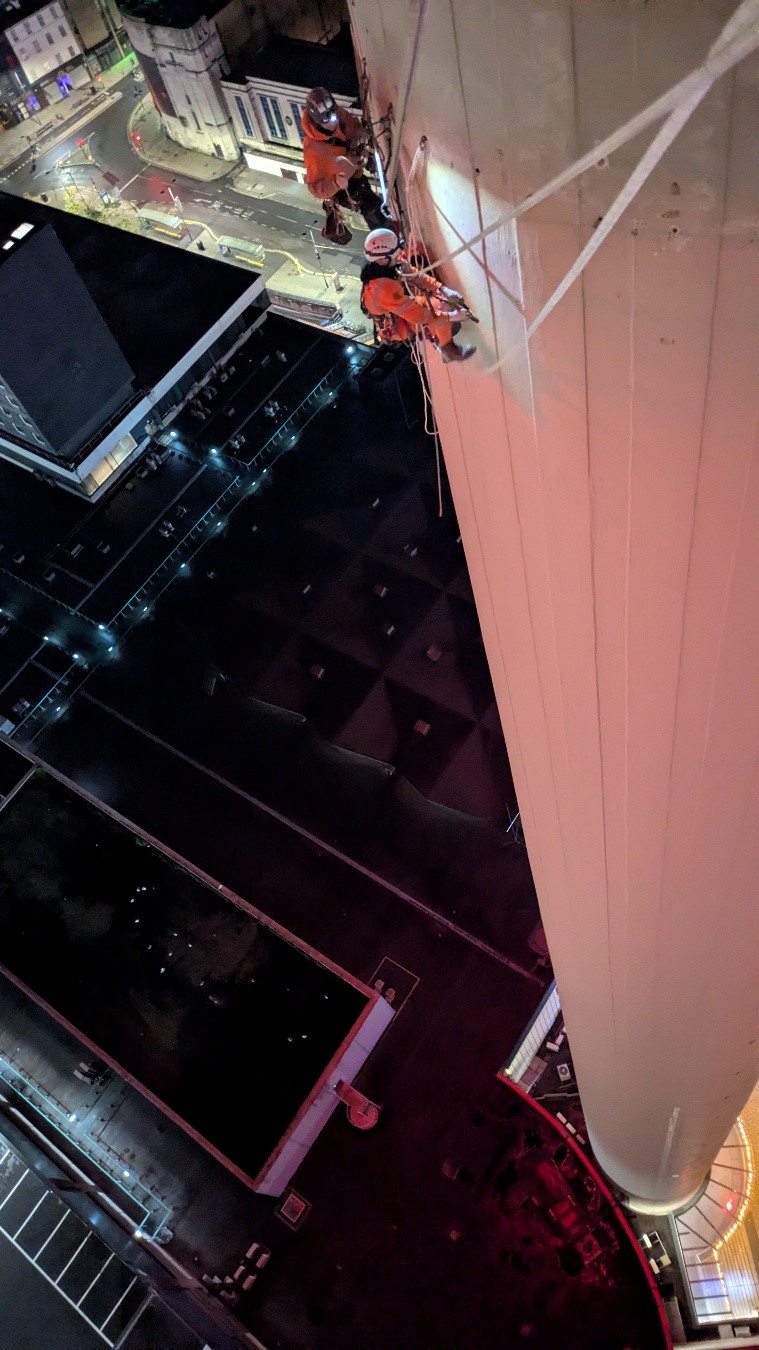
Technicians suspended nearly 140 metres in the air carried out tests on the concrete and steel of St Johns Beacon in Liverpool using specialist rope access techniques.
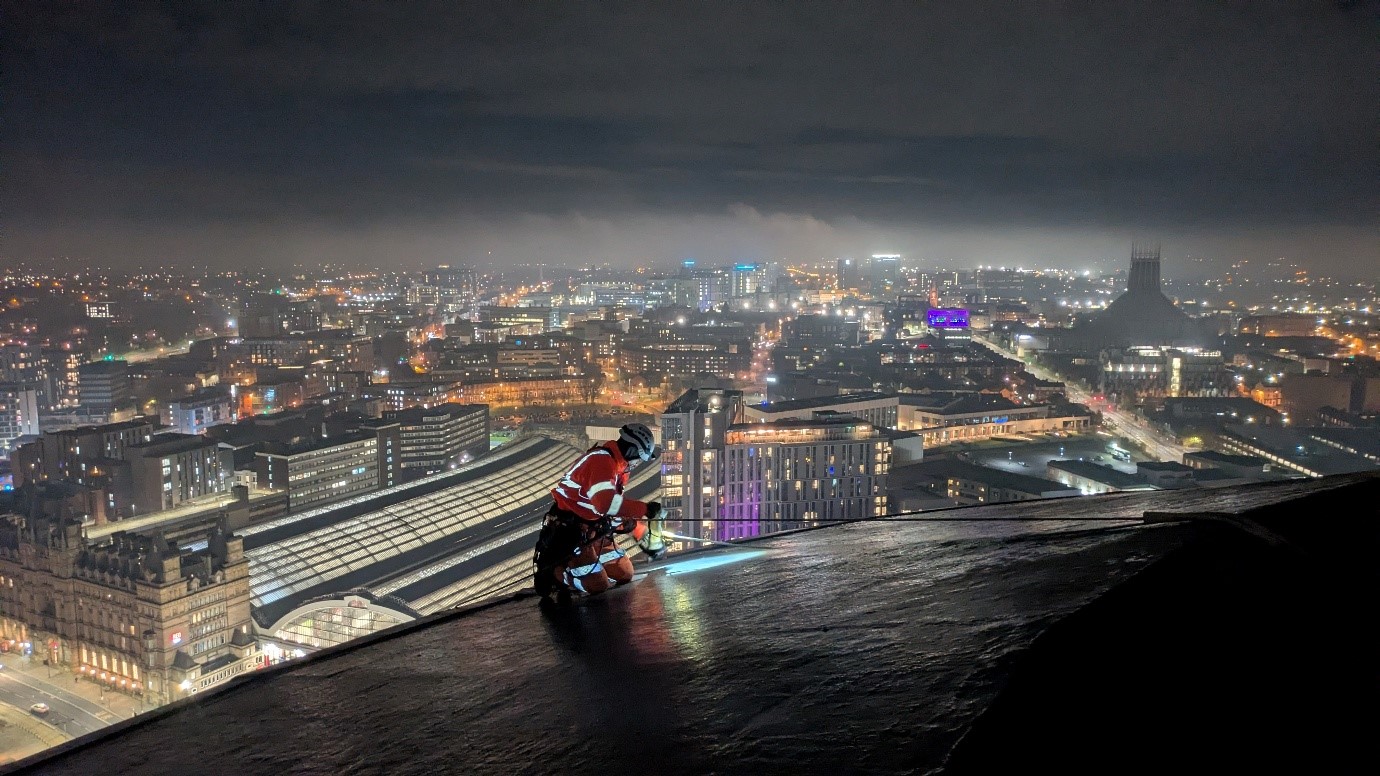
RSK Group company CAN Structures was contracted to carry out a defect survey and concrete testing of the iconic Grade II listed communications tower following previous inspections in 2011 and 2015. Work was carried out on the 138-metre-high St Johns Beacon, originally built in 1969, through the night over the course of nine days so that the streets below could be closed during the works.
CAN Project Manager Louis Thomas said: “We carried out acoustic hammer tests – tap tests – on the entire concrete façade of the tower. Defects were recorded and depth of carbonation and cover meter tests were taken. The steelwork at the top of the tower and the windows to the ‘doughnut’ also received a full visual inspection.
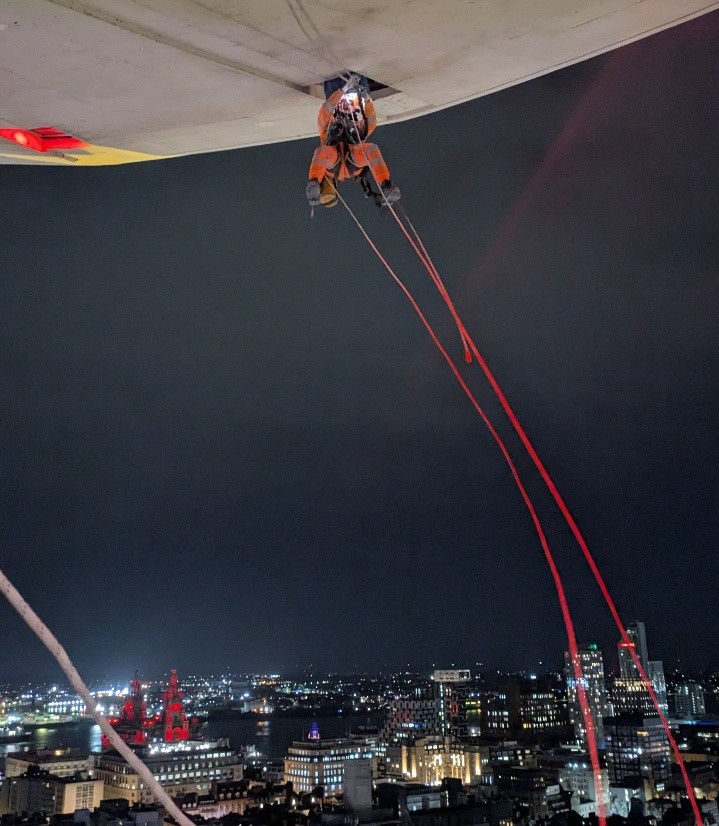
“Access to the underside of the ‘doughnut’ proved particularly challenging. Initial access was gained through lighting openings on the underside of the tower, and we then put up rigging between the adjacent openings. The staging platform we call ‘CAN-Span’ was then winched up from ground level to enable technicians to get within touching distance of the underside of the tower to carry out their inspections.”
Louis explained that, for safety, a considerable cordon was necessary. Several roads, footpaths and pedestrian areas within an extended footprint of the tower were closed by Liverpool City Council.
Munroe K Asset Management manages the building. Director Roger Fulford said: “The Beacon tower is iconic in Liverpool and, like all buildings, needs to be inspected and maintained. For most buildings, the view while doing so is significantly less dramatic. The information gathered during this inspection will be used to assess maintenance schedules and inform us of the condition of the structure so that it can be future-proofed, ensuring it remains an integral part of the city’s skyline for many years to come.”
St Johns Beacon is a notable feature of the city’s skyline and a popular destination for tourists, with the building’s first floor giving visitors 360° panoramic views of the city. It was refurbished between 1999 and 2000 and has been used as a revolving restaurant, a communications tower, offices and a tourist site.

About CAN
The CAN Group, established in 1983, has its head office in Chesterfield and regional bases in London, Bristol, Glasgow and Dublin. CAN is a geotechnical and structural services contractor, utilising specialist access techniques to provide ground engineering, structural installation and maintenance services to the construction and civil engineering sectors throughout the UK.
About RSK
RSK Group is a global leader in the delivery of environmental and engineering solutions. We recognise the urgent need for sustainable change and know that this will be achieved by delivering meaningful action, not just words. We are committed to supporting our clients and societies as they navigate these complex challenges, while making a positive impact.
The business was founded in 1989, originally focused on providing environmental consultancy services to global energy clients. Today, while we remain a leader in environmental consultancy, the business is significantly more diverse. RSK delivers an unrivalled breadth and depth of environmental and engineering services, either as stand-alone projects or as large and integrated multidisciplinary solutions.
The group believes this emphasis on multidisciplinary collaboration is essential for successfully addressing complex global challenges. This is why we have brought together pragmatic advice, forward-thinking engineering, cutting-edge innovation, digital solutions and best-in-class delivery services.
RSK continues to deliver its ambitious growth strategy. It now comprises more than 200 companies and employs over 16,000 people.